

Bioarchitecture is the art of designing and building in harmony with Human Nature and its surroundings, with the aim of creating spaces that provide comfort, beauty, functionality and health, with high efficiency and ecology.
This concept emerged in the early 1960s and is based on analyzing and understanding the resources and biology of places and people, creating efficient, ecological and sustainable solutions that respond to the real needs of those who live in and enjoy these buildings.
Bioarchitecture is an art inspired by Natural Intelligence that has as its basic principles: Ecological impact, efficient management and regeneration of natural resources and materials, health and quality of the indoor environment, and an integrated and efficient design that results in harmony between all elements.
Using ancestral knowledge and combining it with today’s technological advances, it promotes the creation of construction solutions that prioritize natural materials produced regionally, promoting the reduction of pollutants generated during the transformation and movement of raw materials and cultivating local culture, economy and development.
Materials used in bioarchitecture
Although the materials are studied and selected for each case and location, we seek to use materials from renewable sources and fair/circular economy systems, without toxic loads that contribute to good indoor air quality so that they can be reintegrated at the end of the building’s life cycle or returned to nature to continue the transformation cycle.
Here are some examples and techniques used in Bioarchitecture:
Materials:
- earth
- stone
- clay
- natural fibers
- bamboo
- reforestation zone and
- certified wood
- raw and recycled materials.
Techniques:
- adobe brick (mortar made of clay, sand and natural fibers)
- partitions
- green roofs
- wood frame with earth and natural fibers
- wood frame with straw bales
- rammed earth (compacted earth)
- superadobe (bagged and compacted earth)
Some points or technologies to be taken into consideration when we talk about Bioarchitecture
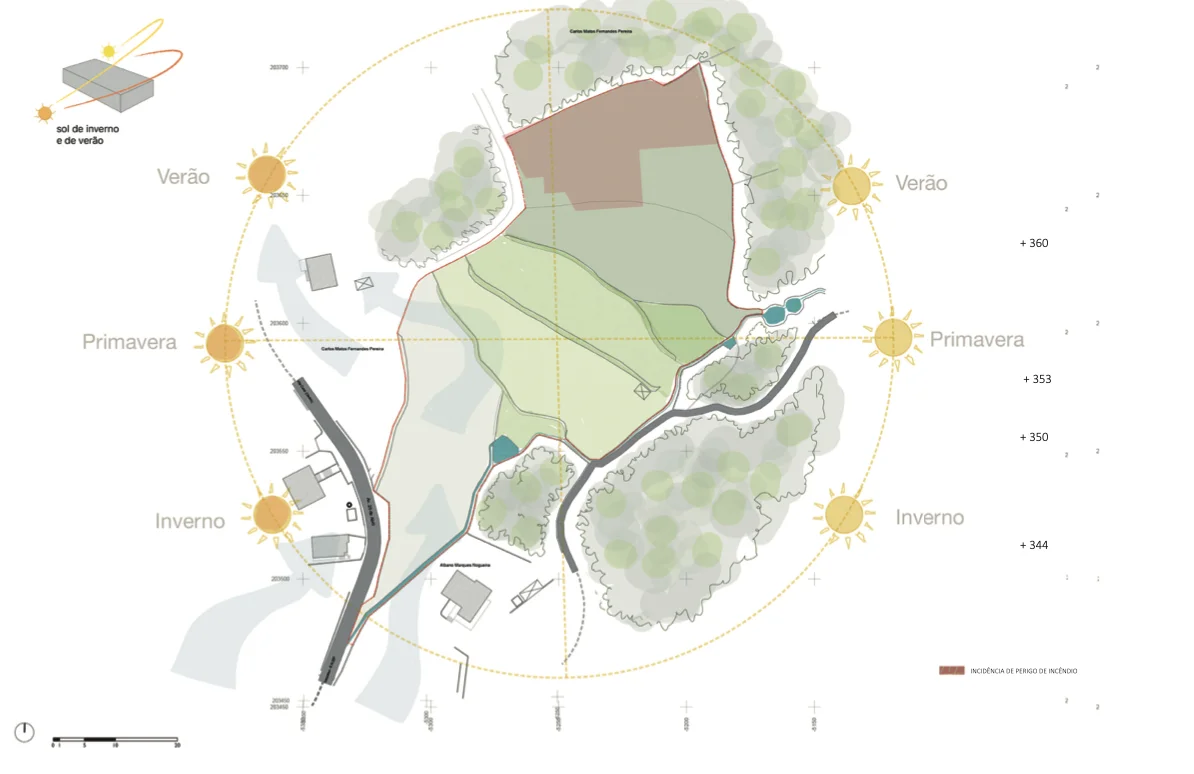
The choice of solutions should be made during the design phase and after we understand the bioclimatic factors and the surrounding resources of the land that we can use (range/variation of the daily and annual temperature of the site, the exposure and incidence of sunlight on the house, the prevailing winds, the surrounding vegetation, etc.).
With this, we can correctly size the facades, windows/glazing, their thermal insulation, as well as the layout of the building. Knowing and adjusting the project to the local reality allows us to minimize our energy expenditure (active system) which should mainly come from renewable sources, such as the sun.
Natural ventilation
In addition to constantly renewing the air that circulates inside the building, natural ventilation makes the indoor environment healthier and more comfortable.
Natural ventilation systems also help to minimize energy costs. This is because they make the use of air conditioning or fans unnecessary.
Cross ventilation is one of the main techniques of this system and occurs when the openings, windows or doors of a building are placed on opposite or adjacent walls, allowing constant air circulation.
To do this, it is necessary to evaluate the direction, speed and frequency of the wind.
Natural lighting
Light is a huge point of attention to be taken into consideration when designing any space and environment.
As we are aware that natural light is a source of energy and influences our psychic and physiological functions, all designs and projects must guide and control the entry of the appropriate type of light into each space. Windows play a fundamental role as catalysts for light, and their correct dimensioning and orientation are extremely important to obtain luminosity without compromising thermal performance.
A well-dimensioned or dynamic external shading helps to contain the strongest rays during hot seasons but allows them to enter during cold seasons, when their action is welcome.
Bioarchitecture costs
In Bioarchitecture, as in conventional architecture or construction, the initial phase of project development and planning is the most important and has the greatest direct impact on people’s lives, but it is also the phase in which most people are most reluctant to invest. This is largely due to the lack of information regarding the real role of the Design team. The value invested in a good team at this stage will be amply compensated in the following phases and throughout the useful life of the building.
Some Bioarchitecture techniques can increase construction costs, as there are not yet many people involved in this type of construction, but they can be competitive with a good quality construction, and certainly competitive and compensatory when we talk about medium and long-term impact, since high energy efficiency has a direct impact on maintenance and health costs.
When designing solutions, we study energy resources such as solar exposure, wind, soil, materials and resources that are easily accessible or already existing on site, and we design and size them according to their best use.
Therefore, ecological properties can cost approximately 5% to 10% more during the construction phase, but they are increasingly valued in the market, and this additional cost/investment can be quickly recovered through efficient energy use, with a potential annual cost reduction of over 50%.
When thinking about Bioarchitecture, it is important to remember that all projects are unique and tailored to each person, family or company, responding to the physical, energy, ecological and functional needs, certainly increasing the levels of comfort, health and productivity of those who live there.
Modern Approach
In fact, for some time in Portugal, due to cultural and local issues, “alternative” construction systems (such as wood, partitions, rammed earth, adobe, stone or a combination of several of these) did not have a sufficient presence or workforce to be explored, reinvented and adapted to today’s reality, making those that existed seem in some way primitive, fragile or unattractive.
Even the story of “The Three Little Pigs” helped to create the myth that if there were no bricks then it was no good, or for lazy people…
This is not true.
However, in several European countries, the USA, Japan, and some countries in Latin America and Asia, this construction culture has always been very much alive and has continued to be developed, redesigned and updated, keeping up with the levels of demand and comfort of new societies.
With easy access to information, this knowledge is now completely globalized and accessible to everyone. Today, in Portugal, we already have several good examples, whether of a purely traditional manufacturing process or one that is already well industrialized, which allows us to have alternative solutions with all the comfort, guarantee and efficiency, and with controlled cost and time. Some of these examples are highly ecologically conscious, mainly in the non-use of materials derived from petroleum or toxic minerals.
It is therefore essential that we are aware and informed of this, so that we can clearly decide what is best for us, for our health and for the Planet, without forgetting our wallet.
So that we can have a home that fully meets our needs.